Deep Dive into Laser Cladding: The Metallurgy of the Bond
For engineers and maintenance managers, the value of laser cladding isn’t just in the material deposited; it’s in how that material attaches to the component. While other surfacing technologies like thermal spray rely primarily on mechanical adhesion, high-power fiber laser cladding (Article #02, #08) creates a definitive metallurgical bond. This superior bond is the core reason cladded components from Intouchray’s machines achieve noble reliability (intouchray.com) in the world’s harshest environments.
Understanding the metallurgy of this bond is essential for fresh learners and experienced operators alike. It requires examining the complex interactions that occur within the melt pool, where precise energy density, diffusion, and controlled dilution determine the integrity of the resulting clad layer.
- The True Metallurgical Bond
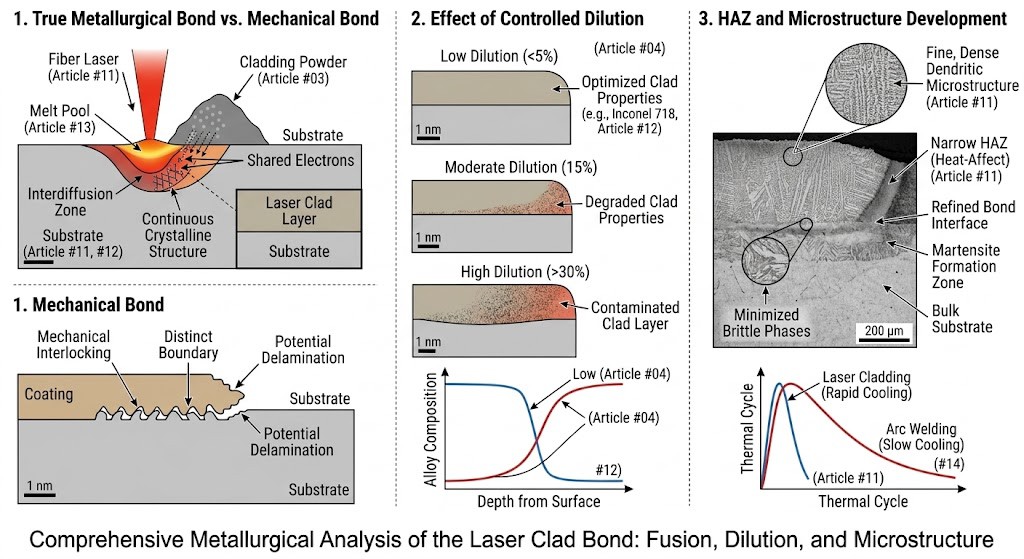
A true metallurgical bond exists when the atoms of the cladding material and the substrate material share electrons, fusing into a continuous crystalline structure across the interface. In laser cladding, this is achieved by using the high-intensity fiber laser (Article #13) to simultaneously melt a very thin surface layer of the substrate and the incoming cladding powder.
Fusion vs. Adhesion: Unlike a mechanical bond (think of tape on a surface), where the materials are merely touching at the macroscopic level, a metallurgical bond eliminates the distinct boundary. The two materials become molecularly continuous. This fusion provides unparalleled adhesion strength, allowing cladded layers to withstand extreme shear forces, impact, and thermal cycling without delamination—a critical failure mode in thermal spray coatings.
- Controlled Dilution: The Defining Balance
The key to a high-quality laser clad bond is managing dilution. Dilution is the intermixing of the substrate material into the clad layer, typically expressed as a percentage of the substrate melted relative to the total clad volume.
Why Dilution Matters: High dilution (Article #04) contaminates the clad layer with chemistry from the substrate (e.g., mixing carbon steel into a nickel-based superalloy, Article #12). This degrades the intended properties (wear or corrosion resistance) of the cladding material.
The Fiber Laser Advantage: The focused, precise energy profile of high-power fiber lasers (Article #13), combined with advanced process control (Article #09), allows Intouchray’s machines to achieve exceptionally low dilution—often below 5%. This is significantly lower than traditional arc welding processes (which can exceed 30% dilution). Low dilution ensures that the noble properties of the specialized cladding material are maintained right from the first layer, maximizing resource efficiency (Article #19) and component performance.
- The Heat-Affected Zone (HAZ) and Microstructure
The extreme concentration of laser energy (Article #02, #08) has another critical metallurgical advantage: a minimal Heat-Affected Zone (HAZ). The HAZ is the area of the substrate that does not melt but is metallurgically altered by the process heat.
Minimized HAZ (Article #11): Because the fiber laser applies intense heat extremely rapidly and precisely, the total heat input into the component is minimized. This results in a very narrow HAZ, reducing the risk of thermal distortion, grain coarsening, and the formation of brittle phases (like martensite) in sensitive substrate steels.
Fine-Grained Microstructure: The rapid heating and subsequent high cooling rates characteristic of laser cladding promote the formation of an exceptionally fine-grained and dense microstructure within both the clad layer and the bond interface. This refined microstructure (as verified by NDT, Article #14) significantly improves the toughness, hardness, and corrosion resistance of the material compared to conventionally cast or welded structures, contributing to leapfrog life extension (Article #11-#13).
Conclusion: The Foundation of Strategic Reliability
The metallurgy of the laser clad bond is not merely a scientific curiosity; it is the definitive foundation of the technology’s success. By achieving a true metallurgical bond with exceptionally low dilution and a minimal HAZ, high-power fiber laser cladding delivers surfaces with unmatched adhesion strength and optimized material properties. This deep understanding of melt pool dynamics (Article #09, #04) and interface metallurgy (Article #11) allows Intouchray (intouchray.com) to engineer solutions where reliability is not just a feature, but a quantifiable strategic asset, ensuring that high-value components operate longer, safer, and with noble efficiency in the most demanding industrial applications.
Image Attachment