In the burgeoning sectors of Liquefied Natural Gas (LNG) transport, aerospace liquid propulsion, and quantum computing infrastructure, materials must operate at temperatures as low as -269°C (4 Kelvin).
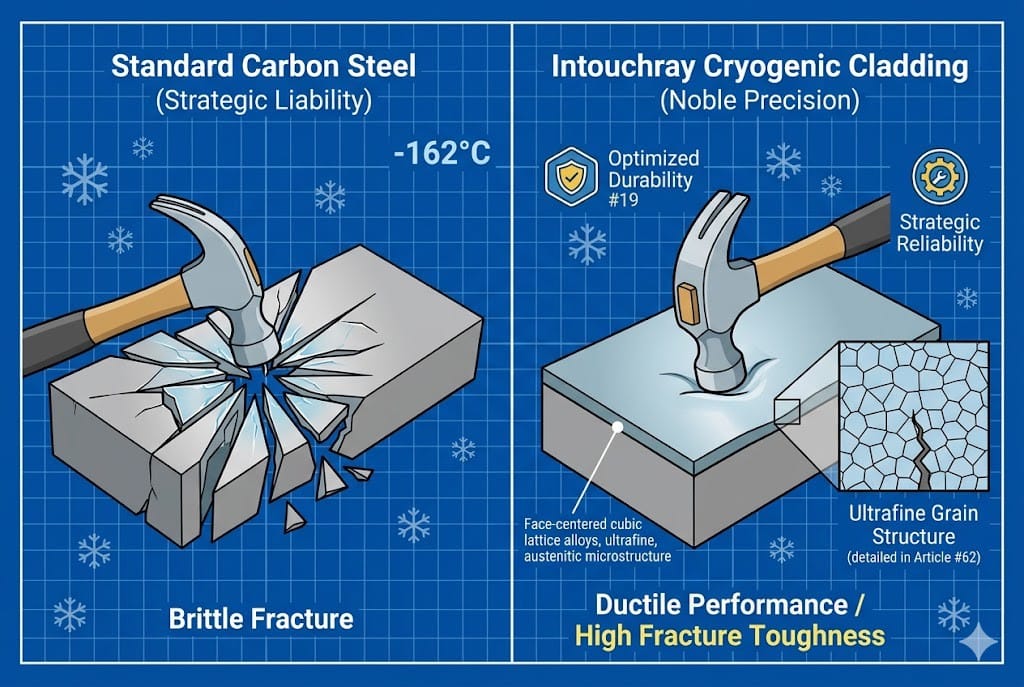
At these cryogenic temperatures, most industrial metals undergo a “Ductile-to-Brittle Transition.” The atomic lattice loses its ability to slide, meaning even a microscopic impact can lead to a shattered component. Intouchray Cryogenic Cladding (intouchray.com) provides a specialized metallurgical solution to keep assets flexible and tough when the world freezes solid.
- The Challenge of the Deep Freeze
Traditional welding in cryogenic applications often introduces “residual stress” and coarse grain structures. These act as “stress concentrators” that invite brittle fracture. Furthermore, many standard alloys simply lack the “Fracture Toughness” required to survive at -162°C (the storage temperature of LNG).
Intouchray Extreme High-Speed Laser Cladding (EHLA) (Article #33) uses noble precision (#13) to deposit specialized FCC (Face-Centered Cubic) lattice alloys, such as high-nickel stainless steels or specialized aluminum bronzes, which do not have a brittle transition temperature.
- Microstructural Refinement: The EHLA Advantage
The secret to cryogenic survival lies in the grain size (Article #62). Large grains provide easy paths for cracks to travel.
Through the rapid solidification of the Intouchray beam, we freeze the material into an ultrafine, austenitic microstructure.
Grain Boundary Density: By increasing the density of grain boundaries, we create a “maze” for fractures. Even at absolute zero, a crack cannot find a straight path through an Intouchray cladded layer.
Phase Stability: Using Closed-Loop Control (Article #34), we ensure the cladded layer remains in a stable austenitic phase, preventing the formation of brittle martensite during the cooling process.
- Applications: From LNG Tankers to Space
LNG Valve Sealing: Cladding 316L or Alloy 625 onto valve seats (Article #58) to ensure zero-leak performance at -162°C.
Liquid Hydrogen (LH2) Storage: As we move toward a hydrogen economy, Intouchray cladding provides the essential hydrogen-permeation barrier (Article #68) that remains ductile at the -253°C temperatures required for liquid hydrogen storage.
Space Propulsion: Cladding internal cooling channels in rocket nozzles that must transition from cryogenic fuel temperatures to combustion heat in seconds.
- ROI: Eliminating the Brittle Failure Risk
A single brittle fracture in a cryogenic manifold can lead to a catastrophic “Cold Spill,” which flash-freezes and destroys surrounding equipment.
Strategic Reliability: Intouchray cladding ensures the “Yield Strength” and “Impact Toughness” of the component are optimized simultaneously.
Optimized Resource Efficiency (#19): Instead of making a massive pump body entirely out of expensive cryogenic alloys, we clad only the critical stress points and sealing surfaces, reducing total material costs by up to 60%.
Conclusion: The Master of Extremes
Article #70 completes our journey through the physical limits of materials. From the crushing pressure of the deep sea to the inferno of the turbine and the absolute zero of space, the “Quantum Beam” has proven its dominance. In Article #71, we begin a new chapter: Volume VI: The Autonomous Factory—The Future of Integrated Laser Production.
Image Attachment