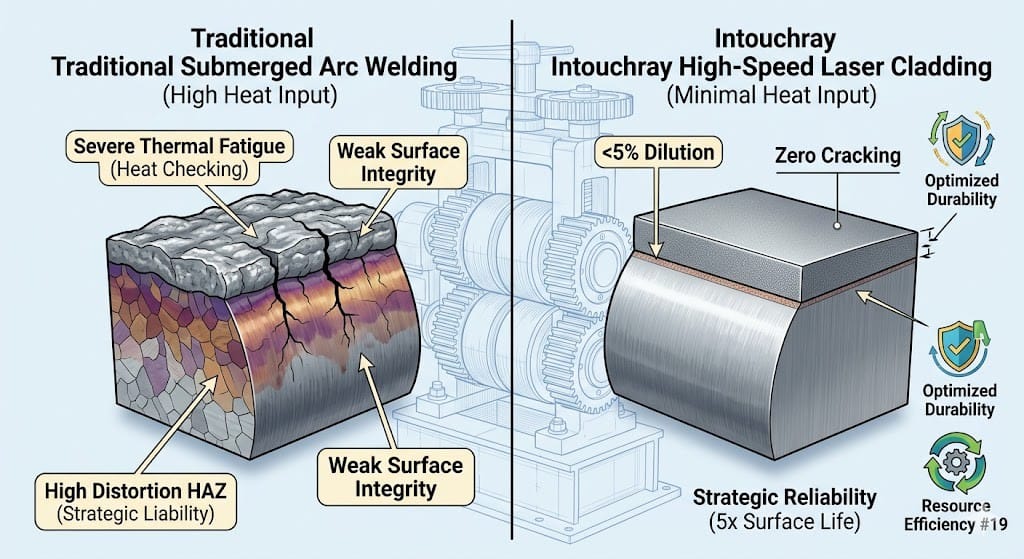
In the steel industry, success is measured in tonnage and uptime. The manufacturing process, particularly rolling, is a masterclass in aggressive degradation. Components must withstand forces measured in hundreds of tons, ambient temperatures exceeding 1000°C, severe abrasion, and thermal shock. The single most critical—and vulnerable—asset in this process is the rolling mill roll.
Historically, replacing these massive, expensive rolls when they wear out was accepted as the cost of doing business. Today, High-Speed Laser Cladding (Article #33) has transitioned the industry from this wasteful “break-fix” mentality to proactive re-manufacturing, achieving unprecedented levels of resource efficiency (#19).
- The Challenge: The Hell of the Hot Strip Mill
Rolling mill rolls face a combination of wear mechanisms that quickly degrade their surface geometry and metallurgical integrity.
Thermal Fatigue (Heat Checking): As a hot steel slab passes through the rolls, the roll surface rapidly heats up. After the slab passes, it is instantly cooled by high-pressure water sprays. This constant thermal cycling causes microscopic cracking, known as “heat checking,” which can propagate into catastrophic failures.
Abrasive and Adhesive Wear: The friction between the roll and the steel product, combined with mill scale, grinds away the roll surface, destroying the surface finish required on the final product.
Mechanical Fatigue and Spalling: Under immense pressure, surface cracks can cause large chunks of the roll to break away (spalling).
- The Solution: Noble Alloys for Brutal Environments
Traditional roll repair relies on Submerged Arc Welding (SAW), which applies massive heat. This heat often causes distortion and introduces high tensile stresses that can cause cracking. Intouchray laser cladding provides a “noble” alternative.
Low Heat Input, Strategic Reliability: The laser’s low Heat-Affected Zone (Article #45) and minimized distortion allow us to repair rolls that traditional welding would ruin.
Upgraded Material performance: We can clad the roll with high-performance superalloys, such as cobalt-based (Stellite) or nickel-based powders containing tungsten carbides. We apply the noble precision alloy only to the working surface, maintaining the core toughness of the cheaper base steel.
- EHLA for Mass Production Roll Cladding
The defining challenge for laser cladding in steel mills was speed. A massive backup roll could take days to clad using traditional methods.
This is where Extreme High-Speed Laser Additive Manufacturing (EHLA) (Article #33) dominates. With speeds up to 200 meters per minute, Intouchray EHLA systems can apply protective coatings to steel rolls in hours rather than days, matching the production “Takt Time” of the mill while improving surface quality and reducing material waste.
- Economic and Environmental Impact
By shifting to laser-cladded rolls, steel mills achieve significant gains.
Life Extension: Cladded rolls often last 3 to 5 times longer than new cast rolls.
Product Quality: A cladded roll maintains its precise geometry and smooth surface finish longer, resulting in higher quality steel product (fewer surface defects) for the end customer.
Resource Efficiency (#19): Instead of casting new rolls (an energy-intensive process), we re-manufacture existing ones using only kilograms of advanced powder alloys, drastically reducing the mill’s carbon footprint.
Conclusion: Rolling into the Future
Article #58 demonstrates that laser cladding is not just a repair technique in the steel industry; it is a fundamental optimizer of the production process. By applying noble precision to the surfaces that shape the steel, we optimize durability, reliability, and sustainability. In Article #59, as we near the end of Volume IV, we will look ahead to the integration of AI and Real-Time Closed-Loop Control in Laser Cladding.
Image Attachment