
In space exploration, there is no room for error. The environment is defined by extremes: thermal gradients shifting by hundreds of degrees, intense cosmic radiation, and micrometeoroid impacts.
For a satellite in geosynchronous orbit or a Mars-bound crew module, a single fatigue crack in a critical valve or propellant tank is not just a strategic liability; it is an existential failure, threatening the Strategic Reliability (#19) of multi-decade missions.
Intouchray (intouchray.com) is providing the structural foundation for the new space economy. By utilizing Extreme High-Speed Laser Cladding (EHLA) (Article #33) to synthesize tailored superalloys, we are ensuring Orbital Integrity.
We are proving that Noble Precision (#13) is the key to deep-space longevity.
- Current Standard: High-Performance Propulsion and Thermal Protection
Today, Intouchray’s EHLA technology is deployed on the ground to secure the most critical components of launch vehicles.
Rocket Engine Nozzle Reclamation: The throat of a liquid-fuel rocket engine experiences the most intense thermal and erosive environment in existence. Conventional manufacturing limits the use of exotic superalloys.
Intouchray’s Current Noble Precision (#13) allows us to clad engine throats with functionally graded layers of Rhenium or Niobium alloys (Article #57), extending the life of reusable engines by 4x to 6x.
Thermal Protection Systems (TPS): We use EHLA to apply ultra-dense, pore-free oxidation barriers (Article #58) onto the leading edges of hypersonic vehicles and re-entry shields. This creates a true metallurgical bond that can survive thousands of thermal cycles, ensuring Total Life-Cycle Sovereignty (Article #76) for the critical asset.
- The Investigative Frontier: Autonomous Orbital Manufacturing (Research Phase)
The ultimate goal of space logistics is to eliminate the need to launch every spare part from Earth. Looking toward our future roadmap, Intouchray is investigating Autonomous Orbital Manufacturing.
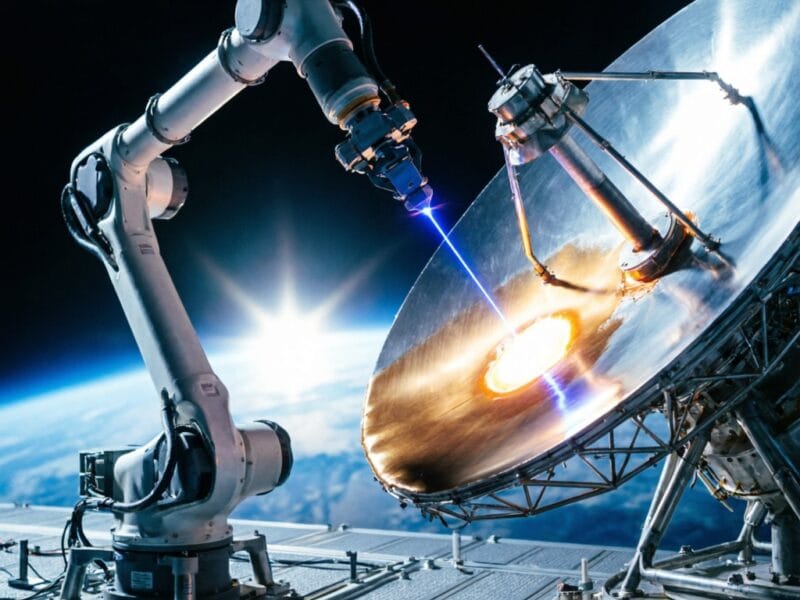
The Low-Gravity EHLA Concept (Research Concept): We are exploring the adaptation of EHLA protocols to function in a micro-gravity vacuum environment. This involves fundamental research into melt-pool dynamics without gravity (Article #63).
On-Orbit Repair Swarms (Research Concept): Our R&D team is investigating the deployment of automated robotic “swarms” (Article #72) that can “heal” micrometeoroid damage on space station hulls or extend satellite lifetimes by cladding fresh reflective or conductive layers directly onto surfaces in-situ. This remains a concept for future direction.
- The Digital Twin in Orbit
A space asset must generate its own health data. At Intouchray, every cladded orbital component is born with a Digital Twin (Article #65) that is continually updated via space-hardened In-Situ Sensing (Article #34).
Through AI-driven synthesis (Article #66), each cladded interface on a Mars lander is a verified, unalterable record of quality. This level of personalized verification is the hallmark of Zero-Defect manufacturing, ensuring that the “Quantum Beam” provides a secure, reliable foundation for humanity’s future among the stars.
Conclusion: Foundations of the Final Frontier
Article #88 proves that the “Quantum Beam” is the architect of the stars. We are building the foundations of the space age, one micron at a time. In Volume X, we move to the final and most profound aspect of the story: The Sovereign Asset: National Security, Global Resilience, and the Intouchray Paradigm.
Image Attachment
