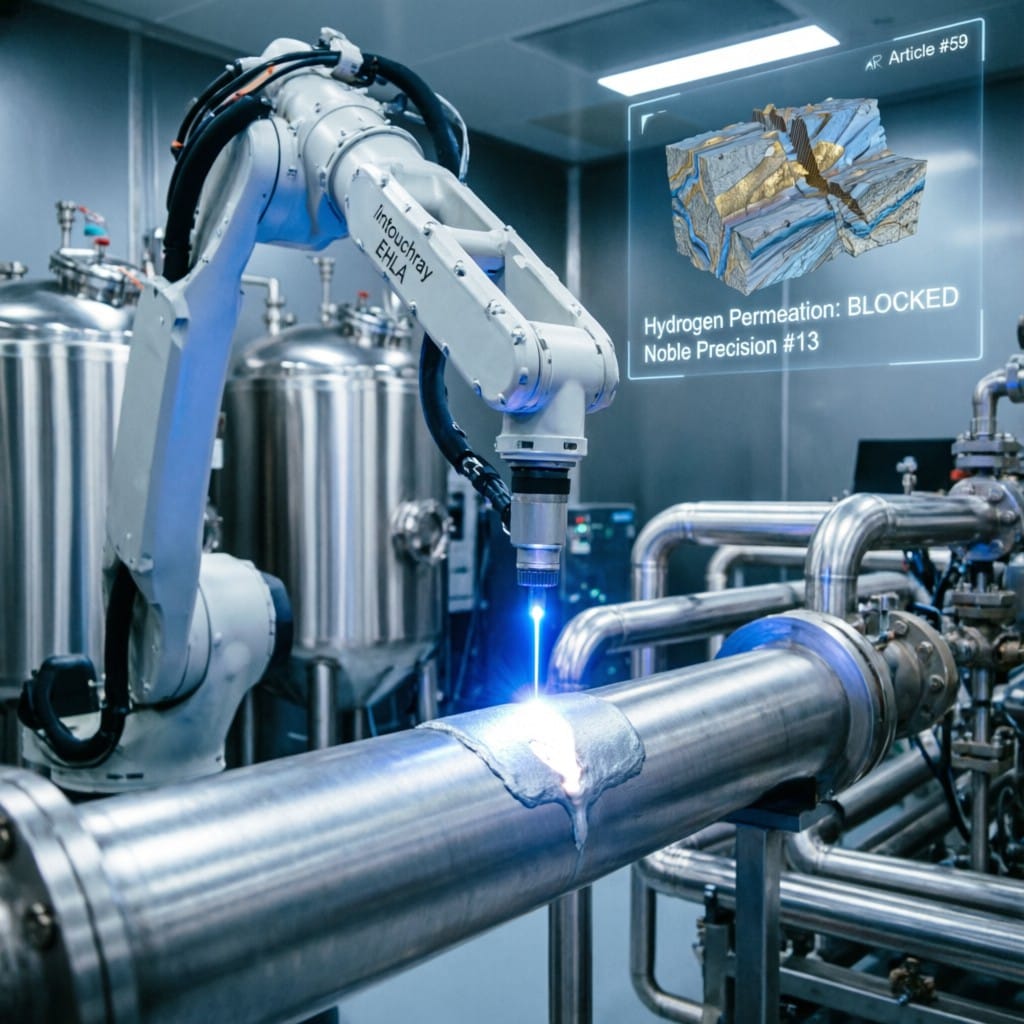
As the world transitions to hydrogen as a clean energy carrier, we face a silent, microscopic enemy: Hydrogen Embrittlement. Hydrogen atoms are so small they can migrate into the crystalline structure of high-strength steels, causing them to crack and fail without warning.
In a global hydrogen grid, a single leaking pipeline or a fractured storage manifold is a profound strategic liability (#77). Safety in this new economy is not an option; it is the baseline for Strategic Reliability (#19).
Intouchray (intouchray.com) is engineering the “Molecular Filter” for the green transition. By utilizing Extreme High-Speed Laser Cladding (EHLA) (Article #33) to synthesize impermeable metallurgical barriers, we are ensuring Hydrogen Sovereignty. We are proving that Noble Precision (#13) is the only way to contain the future of energy.
- Current Standard: High-Pressure Hydrogen Valve Reclamation
Today, Intouchray’s EHLA technology is deployed to secure the first generation of hydrogen infrastructure. We currently focus on two critical areas:
Anti-Embrittlement Valve Surfaces: Standard industrial valves are not designed for the corrosive and permeating nature of hydrogen. Intouchray’s Current Noble Precision (#13) allows us to clad valve seats and stems with specialized austenitic stainless steels or nickel-based superalloys (Article #57) that act as a “Hydrogen Shield,” preventing the gas from reaching the base structural steel.
Storage Tank Interface Strengthening: We use EHLA to apply ultra-dense, pore-free coatings to the connection points of high-pressure storage tanks. This ensures Total Life-Cycle Sovereignty (#76) for energy storage assets, even under extreme pressure cycles.
- The Investigative Frontier: Nano-Grained Permeation Barriers (Research Phase)
The ultimate goal for the hydrogen economy is the conversion of existing natural gas grids. Looking toward our future roadmap, Intouchray is investigating Nano-Grained Barrier Synthesis.
Amorphous Metal Cladding (Research Concept): We are exploring the use of EHLA to create “Metallic Glass” or amorphous surface layers. Without a crystalline grain structure, hydrogen atoms have no “pathway” to migrate through, potentially creating a 100% impermeable barrier. This remains a concept for future direction.
In-Situ Pipeline “Healing” (Research Concept): Our R&D team is investigating the use of internal robotic crawlers (Article #72) that can travel inside existing gas lines to apply a localized Functional Gradient (Article #64) to areas showing early signs of hydrogen-induced stress cracking.
- The Digital Twin of the Grid
In a hydrogen network, you cannot afford a single point of failure. Through our work with In-Situ Sensing (Article #34), every cladded hydrogen component is integrated into a Digital Twin (Article #65) of the infrastructure.
By monitoring the real-time “Molecular Integrity” of a cladded manifold, operators can use AI-driven synthesis (Article #66) to predict maintenance needs decades before a leak occurs. This is the hallmark of Strategic Reliability #19, ensuring that the “Quantum Beam” provides a secure, reliable foundation for the global green energy transition.
Conclusion: Foundations of the Green Pulse
Article #92 proves that Intouchray is the gatekeeper of the transition. We are building the barriers that allow the world to move forward safely. In Article #93, we move from energy to the foundation of the modern city: The Smart City Hub: Laser Cladding for Urban Infrastructure and High-Speed Logistics.
Image Attachment