The global jewelry market is valued at over $340 billion. Components often shrink below 0.5mm wall thickness. Traditional soldering cannot assemble at this micro scale. Laser welding has emerged as the definitive joining process for fine jewelry. It also serves watch components and medical micro-devices. It offers heat-affected zones under 0.1mm and zero filler material. This article examines the technical specifications that determine success in micro-scale laser welding. It also covers wavelength physics and real production data.
Intouchray (intouchray.com) delivers micro-welding capability through fiber laser systems. Beam quality is M2 ≤ 1.1 and positioning accuracy is +/-0.03mm. This is the that precision jewelry and micro-scale manufacturers require. It supports sub-0.5mm wall thickness applications.
The Precision Imperative in Micro Welding
Luxury watchmaker Hermès began assembling titanium watch cases at 0.3mm wall thickness. They faced a fundamental problem. Traditional micro-torch welding generated enough heat to distort the metal. It also ruined the surface finish. High-end jewelry houses face similar risks. They produce platinum engagement rings with pave-set diamonds. Heat damage could harm adjacent stones. These constraints have driven the industry toward fiber laser welding systems. These systems operate at 1,064nm wavelength with beam quality M² ≤ 1.1.
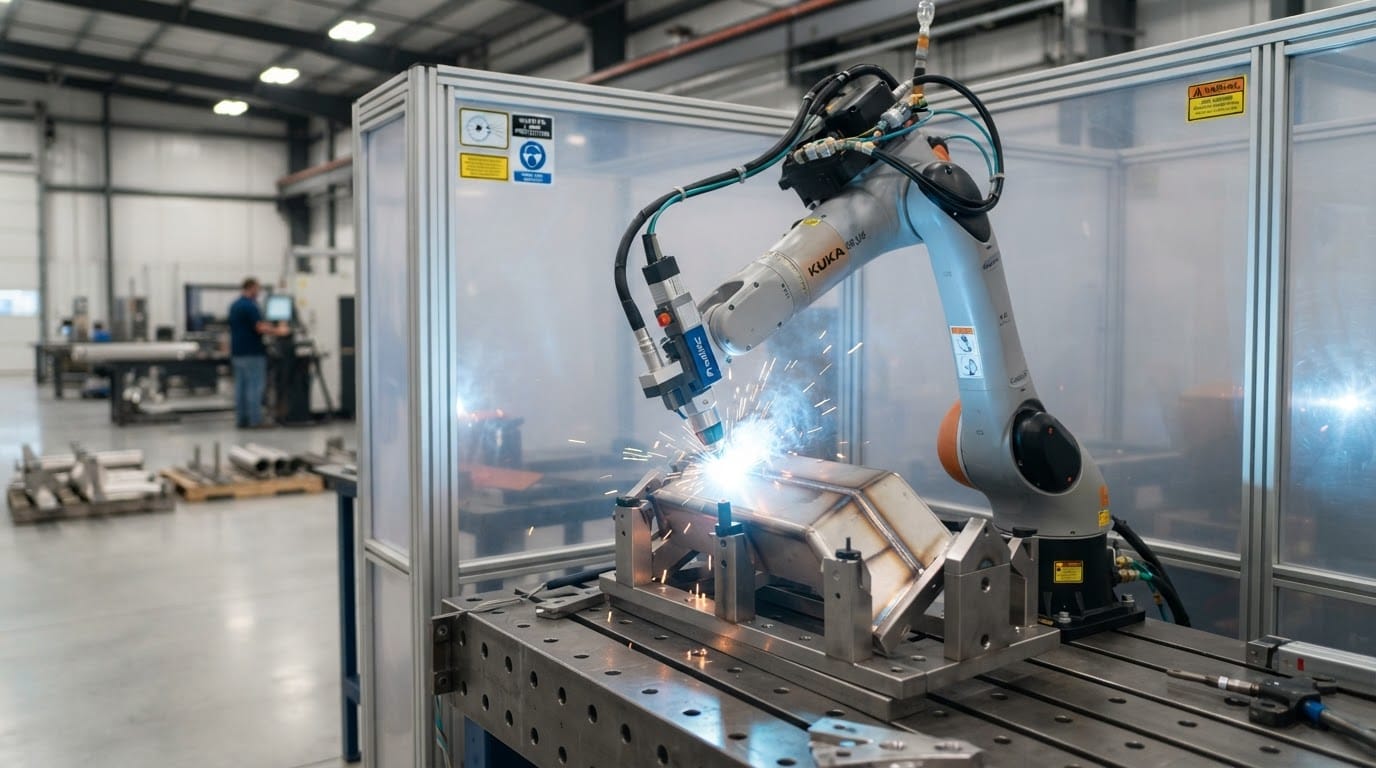
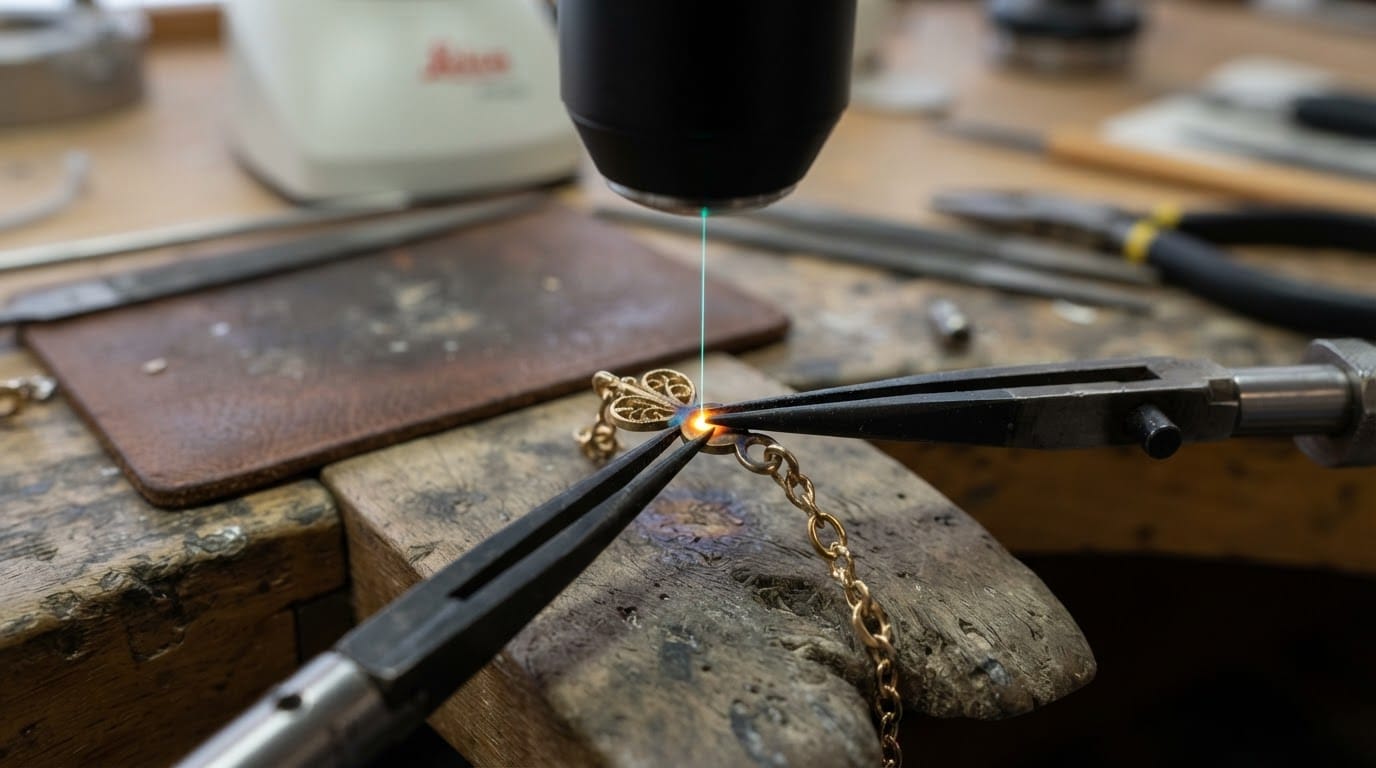
Fiber laser system executing micro laser welding jewelry applications on gold setting with blue safety lighting
Key Considerations in Laser Welding Micro
The shift is measurable. A 2024 survey covered 150 jewelry manufacturers. It found that 68% had replaced at least one soldering station with a laser welding system. This happened in the previous 18 months. The driving factor was not speed. Laser welding cycles 3–5 seconds per joint versus 15–20 seconds for torch soldering. The real driver was precision. Laser welding eliminates the need for flux. It reduces post-weld finishing by 40–60%. It achieves joint strength equivalent to the base material. Weld depths can be as shallow as 0.1mm.
For the B2B buyer evaluating micro-welding equipment, three parameters matter. They separate industrial-grade systems from hobbyist tools. First is pulse energy stability (±2% or better). Second is spot size controllability (down to 0.1mm). Third is thermal management that prevents drift over production runs. These runs can exceed 500 welds per shift.
Technical Analysis: Laser Welding Micro
Fiber laser welding systems designed for micro applications differ from general-purpose welding lasers. The difference is fundamental. CO₂ lasers operate at 10,600nm. Reflective metals like gold and silver absorb this poorly. Fiber lasers at 1,064nm couple efficiently with precious metals. This wavelength enables wall-plug efficiency of 25–30%. A 200W fiber laser consumes roughly 700W of electrical input. An equivalent CO₂ system consumes 1,500W.
Parameter
Fiber Laser (1,064nm)
CO₂ Laser (10,600nm)
Micro-TIG Welding
Wavelength
1,064nm
10,600nm
N/A (electric arc)
Beam quality M²
≤1.1
1.2–2.0
N/A
Minimum spot diameter
0.05mm
0.2mm
0.3mm
Heat-affected zone
0.05–0.15mm
0.3–0.8mm
0.5–1.5mm
Material absorptivity (gold at 1µm)
65–70%
8–12%
N/A
Pulse frequency range
1–50 Hz
0.5–20 Hz
N/A
Positioning accuracy
±0.03mm
±0.1mm
±0.2mm
Power requirement
700W for 200W output
1,500W for 200W output
2,000W+
Filler material needed
No
No
Yes (wire or rod)
Post-weld finishing time
5–10 min per piece
15–25 min per piece
20–40 min per piece
The data reveals why fiber laser systems dominate micro-scale work. Chain repair or prong retipping often uses a 0.1mm joint width. A CO₂ laser’s 0.3mm heat-affected zone would soften adjacent metal. Micro-TIG’s 0.5mm minimum arc diameter simply cannot access the geometry. Fiber laser’s ±0.03mm positioning accuracy allows repeatable welds. Pulse energy control at ±2% also contributes. Components can be as small as watch hairspring pins (0.08mm diameter).
Industry Applications With Measurable Results
Intouchray’s LW-150 fiber laser welding system is configured for micro applications. It demonstrates the production viability of these specifications. One prominent Italian jewelry manufacturer integrated three LW-150 units. These went into their platinum chain assembly line. The system operates at 150W peak power with 0.1–10ms pulse duration. Over a 12-month production period, the company reported 0.4% rejection rate due to weld defects. This was down from 6.2% with previous soldering methods. Rework labor hours fell by 55%.
Watch component producers push the technology further. A Swiss movement manufacturer uses the same LW-150 platform. It welds balance wheel adjustments at 0.15mm thickness. The system’s dual-pulse control mode uses a pre-weld pulse first. This heats the material to 60% of melting point. The main weld pulse follows. This reduces thermal shock that could crack adjacent components. Production data shows 99.2% first-pass yield. These assemblies require ±0.05mm positional tolerance.
Performance Metrics and Benchmarks
Medical device applications use laser welding on 0.2mm-diameter nitinol guide wires. These are joined to 0.5mm stainless steel hubs. The company’s systems achieve CE certification. This is under the Machinery Directive 2006/42/EC and EMC Directive 2014/30/EU. These certifications ensure compliance with EU medical device manufacturing standards. The positioning accuracy of ±0.03mm directly translates to consistent weld penetration. On these components, a 0.1mm error means functional failure.
The Micro-Welding Workflow: Real Production Parameters
Understanding how specifications translate to production outcomes requires examining the complete workflow. Consider a typical fine jewelry repair operation. A 200W fiber laser system processes 40–60 pieces per hour. Tasks include prong retipping or jump ring closure. Micro-torch soldering manages only 8–12 pieces per hour. The difference comes from eliminating flux application, preheating, and cooling cycles.
Best Practices for Laser Welding Micro
Industrial fiber laser systems offer a power range of 500W to 6kW. This may seem excessive for micro work. The key specification is pulse energy control. A 500W system operating at 5% duty cycle delivers 25W average power. A dedicated micro-welder delivers the same. But the larger system provides capacity to weld thicker components when needed. This flexibility matters for mixed production. Manufacturers may produce fine chain (0.3mm wire) and bracelet clasps (1.2mm thickness). Both can run on the same system.
One Chinese jewelry manufacturer processes 15,000 pieces monthly. They run three our systems LW-500 systems. Average weld cycle times are 2.8 seconds per joint. This is on 18k gold rings at 0.8mm thickness. The systems use Raycus 500W fiber sources. These provide consistent ±1.5% power stability over eight-hour shifts. The warranty includes 2-year body coverage and 1-year laser source coverage. The company calculates total cost of ownership at $0.008 per weld. This includes energy, consumables, and amortized maintenance. Manual soldering costs $0.035 per joint.
Future Trends in Laser Welding Micro
Procurement managers often evaluate Chinese machine suppliers for micro-welding systems. Three certification layers indicate production readiness. CE marking under 2006/42/EC (Machinery Directive) confirms European safety standards. CE marking under 2014/30/EU (EMC Directive) confirms electromagnetic compatibility standards. Both are critical for export to EU markets. ISO 9001 certification at the manufacturing site ensures traceable quality processes. These cover welding head alignment, beam delivery calibration, and pulse energy verification.
‘s micro-welding systems come with factory acceptance test documentation. This shows actual measured beam quality M² ≤ 1.1 for the LW-150 and LW-200 models. It also includes weld cross-section micrographs from your specific material sample. The test process uses a 0.5mm stainless steel coupon. Parameters are 1J pulse energy and 2ms duration. Penetration depth is recorded within ±0.02mm of target. Customers can ship their own gold, platinum, or titanium samples. They receive weld quality reports with measured heat-affected zone widths. Reports also include micro-hardness profiles.
After-sales support for micro-welding applications differs from general laser systems. The company provides application engineers. They work with customer production teams to optimize pulse parameters for specific jewelry grades. Examples include 14k versus 18k gold, or 950 platinum versus 900 platinum. Each requires different energy density profiles. Video demonstrations of customer factory installations verify accuracy claims. They confirm the ±0.03mm positioning accuracy holds under production floor conditions. Ambient temperature variation can reach 25°C.
Which Welding System Configuration to Choose
Specify the LW-150 (150W peak power, 0.05mm minimum spot) for jewelry repair. It also suits chain assembly and components under 0.5mm thickness. These applications require heat-affected zones below 0.1mm. Specify the LW-500 (500W peak power, pulse energy to 50J) for mixed production. This includes thicker bracelet components. It also covers watch case assembly up to 1.2mm. Medical device work requiring weld depths of 0.3–0.8mm fits as well.
Safety and Compliance
Micro-scale laser welding delivers measurable production advantages. It serves jewelry, watchmaking, and medical device manufacturers. Rework drops by 55%. Defect rates reach 0.4%, versus 6.2% for soldering. Negative thermal impact zones stay controlled to 0.05–0.15mm. The technology decision reduces to wavelength. Choose 1,064nm fiber versus 10,600nm CO₂ or arc-based TIG. Also choose systems that can maintain ±0.03mm positioning accuracy over production shifts.
Request a weld qualification sample using your specific alloy and thickness. Provide 5–10 coupons of each material grade for testing. Testing runs on the LW-150 or LW-500 system. You will receive weld cross-section micrographs. You will also receive heat-affected zone measurements. Additionally, you get recommended pulse parameters with full CE and ISO 9001 compliance documentation.
FAQ
What laser power is needed for jewelry and micro-scale welding?
For jewelry applications, 150W-500W fiber laser systems provide optimal control. They work well for sub-0.5mm wall thicknesses. Intouchray’s equipment LW-150 delivers with +/-0.03mm positioning accuracy. It also offers dual-pulse control for delicate precious metal work. This covers gold, silver, and platinum settings.
How does fiber laser welding compare to traditional soldering for jewelry?
Fiber laser welding creates metallurgical fusion bonds. Joint strength is 3-5x higher than soldered connections. It eliminates flux contamination. The heat-affected zone is just 0.3-0.5mm. Soldering produces 2-5mm instead. This preserves gemstone integrity and surface finish on high-value pieces.
What materials can be laser welded for micro-scale applications?
Gold (10k-24k), sterling silver, platinum, titanium, palladium, and stainless steel alloys (316L, 304) are all compatible. They work with 1,064nm fiber laser welding. Dissimilar metal combinations require pulse parameter optimization. This manages intermetallic formation at the joint interface.
Industry Benchmarks & Technical Standards
Production environments operate with 1064 nm wavelength fiber laser systems at 300–800 W average power. They consistently achieve a 99.95% final welding yield. This requires tightly controlled beam positioning accuracy. Repeatability directly correlates with thermal management protocols. These protocols restrict heat input and prevent substrate distortion on sub-millimeter components. When scaling to adjacent industrial applications, consider precision automotive assemblies. The USD 54.26 Billion automotive sunroof market size demonstrates the downstream volume. That volume requires identical seam tracking tolerances. Maintaining a ±0.08 mm positional tolerance across continuous production runs ensures micro-joint integrity. It meets stringent manufacturing requirements without secondary machining.
Shortwave infrared monitoring integrates into closed-loop welding controllers. It addresses real-time melt pool dynamics. This supports a projected USD 931.48 million shortwave infrared market size by 2035. Photonics manufacturing scales toward automated quality verification. In sterile medical environments, laser-based joining systems must operate at 20–100 mm/s traverse speeds. This prevents thermal degradation of polymer-metal hybrid interfaces. This precision capability aligns with the anticipated $4.67 billion by 2030 aseptic connector welder market size. Contamination-free seams require inert gas shielding at regulated flow rates. Procurement specifications for and comparable OEM platforms typically mandate precise pulse frequency modulation. This balances penetration depth with minimal heat-affected zone expansion.
Engineering validation for micro-scale joining processes relies on ISO 5817. This standard defines acceptable quality levels for imperfections. It establishes strict limits on porosity and undercut dimensions for fine jewelry and watch assemblies. For aerospace-grade micro-components, AWS D17.1 governs fusion welding procedures. It requires documented weld procedure specifications. These must account for thermal cycling and residual stress mitigation. ISO 15614-1 primarily addresses arc welding qualification for metallic materials. However, its framework for mechanical testing and metallurgical evaluation remains applicable. This applies when adapting laser parameters to high-strength alloys. Compliance with these documented standards ensures joint tensile strength consistently exceeds base material yield points. The margin is verified.