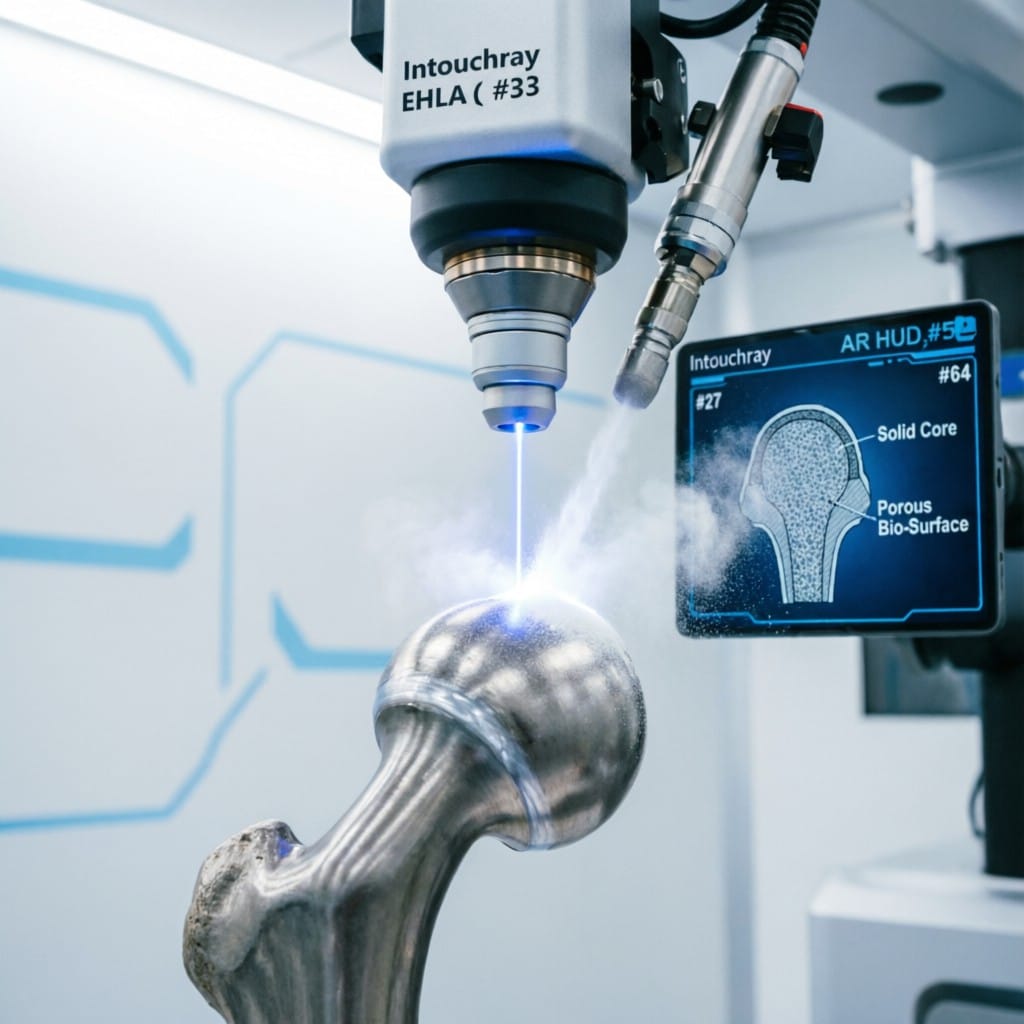
In the medical sector, the failure of an implant is a profound strategic liability (#77). Traditional implants—hip joints, knee replacements, and spinal cages—often suffer from two primary issues: wear-induced toxicity and “stress shielding,” where the stiff metal causes the surrounding bone to weaken.
Achieving Strategic Reliability (#19) in the human body requires a material that is not just “compatible,” but “integrated.”
Intouchray (intouchray.com) is redefining the standard for medical longevity. By utilizing Extreme High-Speed Laser Cladding (EHLA) (Article #33) to synthesize tailored surfaces, we are moving from “Static Implants” to “Living Interfaces.” We are proving that Noble Precision (#13) is the key to life-long mobility.
- Current Standard: Wear-Resistant Orthopedic Prototyping
Today, Intouchray’s EHLA technology is used to prototype next-generation orthopedic components that far exceed the performance of cast or machined parts. We currently focus on two critical areas:
Cobalt-Chrome Surface Hardening: For joint replacements, friction is the enemy. We use EHLA to apply ultra-dense, pore-free layers of specialized alloys (Article #57) onto titanium substrates.
This combines the lightweight strength of titanium with a mirror-finish wear surface that minimizes debris, ensuring Total Life-Cycle Sovereignty (Article #76) for the patient’s mobility.
Complex Geometry Prototyping: Using our current Noble Precision (#13), we can prototype patient-specific implants with varying densities, ensuring that the implant’s stiffness matches the patient’s bone density to prevent bone loss.
- The Investigative Frontier: Bioactive Surface Synthesis (Research Phase)
The ultimate goal of medical cladding is “Osseointegration”—where the bone grows directly into the metal. Looking toward our future roadmap, Intouchray is investigating Bioactive Synthesis.
Porous Metamaterial Deposition (Research Concept): We are exploring the use of EHLA to deposit functionally graded “lattice” structures (Article #64) onto the surface of an implant.
These microscopic lattices (Article #63) mimic the structure of natural bone, encouraging rapid biological bonding.
Antimicrobial Infusion (Research Concept): Our R&D team is investigating the “doping” of the cladding melt pool with trace amounts of silver or copper ions to create a permanent, antimicrobial surface that prevents post-surgical infection. This remains a concept for future direction.
- The Digital Twin of the Patient
The success of a medical implant depends on precision. At Intouchray, every medical prototype is governed by a Digital Twin (Article #65) derived from the patient’s own CT/MRI data.
Through In-Situ Sensing (Article #34) and AI-driven synthesis (Article #66), each layer of the biocompatible bond is verified against the patient’s unique physiological requirements.
This level of personalized verification is the hallmark of Zero-Defect manufacturing, ensuring that the “Quantum Beam” provides a secure, reliable foundation for human health.
Conclusion: The Human Synthesis
Article #87 proves that the “Quantum Beam” can be as gentle as it is powerful. We are building the future of human recovery, one micron at a time. In Article #88, we move from the body to the stars: Orbital Integrity: Laser Cladding for Space Exploration and Satellite Longevity.
Image Attachment