When we discuss “Civil Infrastructure,” we are talking about assets designed to last for a century: hydroelectric dams, suspension bridges, high-speed rail networks, and massive floodgates. For these assets, a single millimeter of corrosion or wear is not just a maintenance issue; it is a strategic liability (#77) of national proportions.
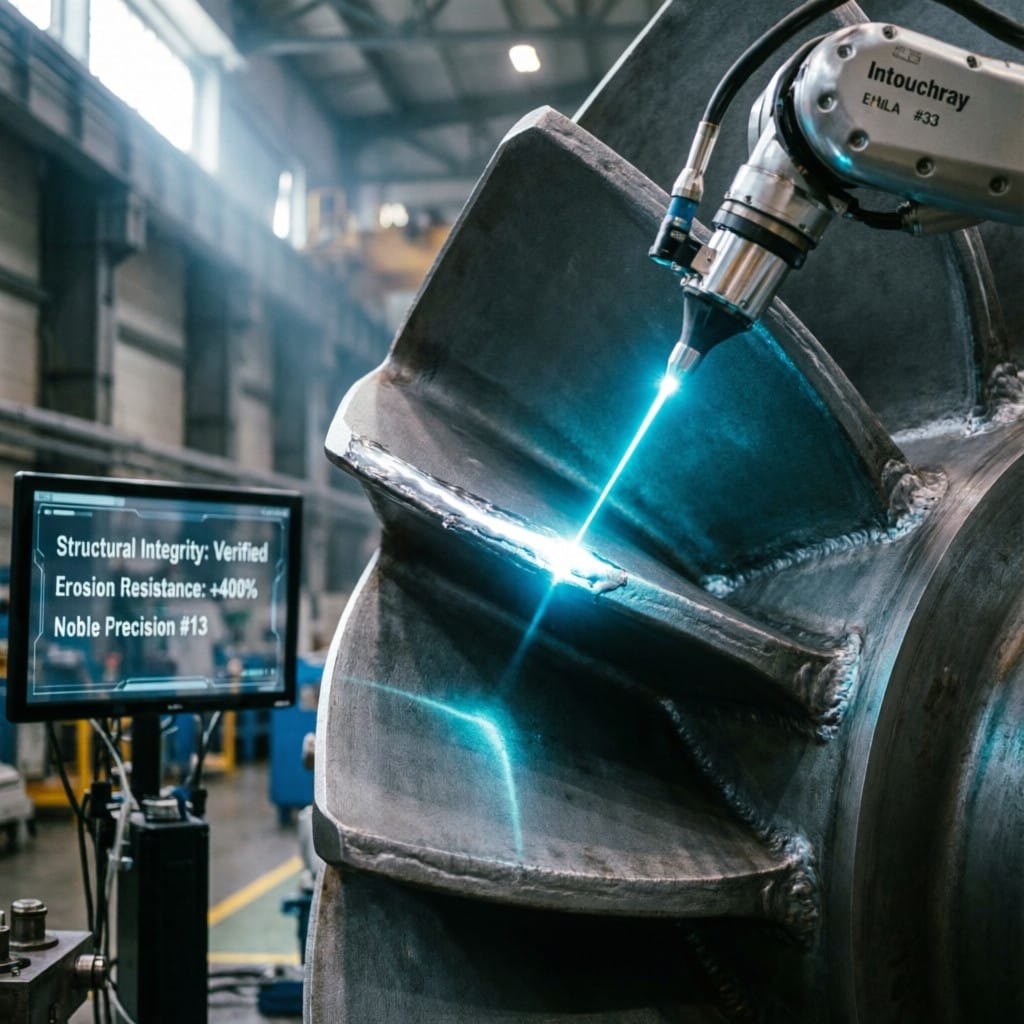
Intouchray (intouchray.com) is redefining the durability of these “Vital Organs.” By applying Extreme High-Speed Laser Cladding (EHLA) (Article #33) to the largest components on earth, we are ensuring Strategic Reliability (#19) at a massive scale. We are moving from a world of “Sacrificial Coatings” to a world of Sovereign Metallurgy.
- Current Standard: The Shielding of Critical Components
Today, Intouchray technology is deployed to protect the high-wear interfaces of massive infrastructure.
Hydroelectric Sovereignty: The massive turbine runners and wicket gates (Article #58) of a dam face constant cavitation and silt erosion. Conventional thermal spray coatings often delaminate. An Intouchray EHLA-cladded surface creates a true metallurgical bond that can extend the operational life of a turbine by 3x to 5x.
Marine & Port Infrastructure: The massive hydraulic rams used in sea locks and port cranes are subject to extreme salt-spray corrosion. Intouchray’s current Noble Precision (#13) allows for the application of ultra-thin, pore-free stainless steel or nickel-alloy layers, providing a “Permanent Shield” that prevents catastrophic structural failure.
- The Investigative Frontier: On-Site Robotic Synthesis (Research Phase)
The primary challenge of “Macro” infrastructure is that you cannot bring the bridge to the factory. Looking toward our future roadmap, Intouchray is researching On-Site Autonomous Synthesis.
The Mobile EHLA Crawler (Research Concept): We are exploring the development of specialized, weather-shielded robotic platforms that can “climb” a bridge pylon or a dam face to perform precision cladding in-situ.
Dynamic Structural Reinforcement (Research Concept): Our R&D team is investigating how to use Generative Design (Article #74) to “print” localized structural reinforcements onto aging steel bridges, effectively “healing” stress fractures with high-strength Metamaterials (Article #63) without a full teardown.
- Integrating the Digital Twin into the Concrete
A dam or a bridge is no longer just a “dumb” object. Through our work with Digital Twins (Article #65), the cladded components of these structures are now data-generating nodes.
By monitoring the wear and stress on a cladded high-speed rail bearing or a bridge expansion joint through In-Situ Sensing (Article #34), engineers gain Total Life-Cycle Sovereignty (Article #76). We can predict when a component needs maintenance decades in advance, ensuring that the infrastructure of the nation remains an unbroken, reliable asset.
Conclusion: Foundations of the Future
Article #85 proves that the “Quantum Beam” is the invisible thread holding our cities together. We are building for the next century, one micron at a time. In Article #86, we zoom into the “Micro” scale: The Precision Pulse: Micro-Cladding and the Future of High-Tech Electronics.
Image Attachment