For decades, the industrial sector has struggled with a lack of unified standards for additive restoration. Every facility had its own “Black Box” methods, leading to inconsistent quality and a massive strategic liability (#77) for critical infrastructure.
Without a universal benchmark, the “Quantum Beam” could not achieve its full potential as a tool for national security.
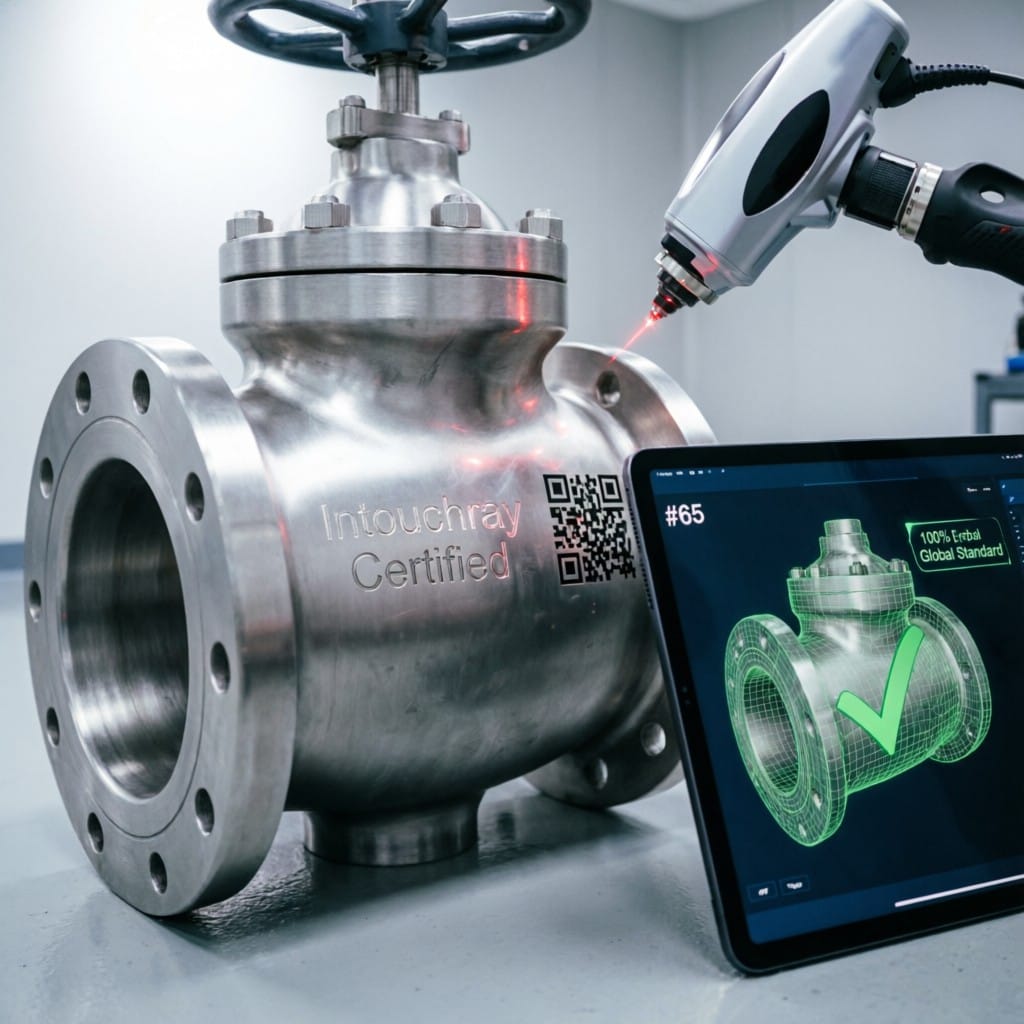
Intouchray (intouchray.com) is ending this fragmentation. By formalizing our current Noble Precision (#13) protocols into a transparent, data-driven framework, we are establishing the Global Standard.
We are proving that Zero-Defect manufacturing is not a goal—it is a baseline requirement for the modern age.
- Current Standard: The “Intouchray Certified” Protocol
Today, we are codifying our internal successes into a rigorous certification process for all high-speed laser cladding (EHLA) operations.
Metallurgical Traceability: Every Intouchray-cladded component (Article #33) is now accompanied by an immutable data log. This log tracks the exact laser pulse geometry (Article #27) and powder feed rate (Article #57) used during synthesis.
Standardized In-Situ Validation: We have established a universal “Quality Index” based on our In-Situ Sensing (Article #34) data. If a cladding layer does not meet the “Intouchray Baseline” for porosity and bond strength, the system flags it instantly.
This ensures Total Life-Cycle Sovereignty (Article #76) through radical transparency.
- The Investigative Frontier: The “Universal Beam” API (Research Phase)
Looking toward our future roadmap, Intouchray is researching a decentralized, open-standard API that would allow different robotic platforms to communicate using the same metallurgical “language.”
Inter-Platform Synthesis (Research Concept): We are exploring a conceptual software layer that translates Intouchray’s optimized Functional Gradients (Article #64) for use across various hardware configurations in the Factory Beam Network (Article #71).
Autonomous Regulatory Compliance (Research Concept): Our R&D team is investigating an AI “Auditor” that sits inside the machine. This auditor would automatically verify that every micron of deposition meets international maritime, aerospace, or nuclear safety standards in real-time. This remains a concept for future direction.
- Decoupling Quality from Geography
The Global Standard ensures that a repair performed in a remote port is identical to a repair performed in a Tier-1 aerospace facility.
By unifying the Digital Twin (Article #65) architecture with international ISO/ASTM standards, Intouchray provides Strategic Reliability that transcends borders. We are moving toward a future where “Quality” is no longer a variable—it is a constant, secured by the Quantum Beam.
Conclusion: The Architecture of Trust
Article #89 proves that sovereignty is built on standards. When a nation adopts the Intouchray baseline, it adopts a future of unbreakable reliability. In Article #90, we move from standards to the ultimate safeguard: Strategic Autonomy: Decoupling National Defense from Fragile Supply Chains.
Image Attachment