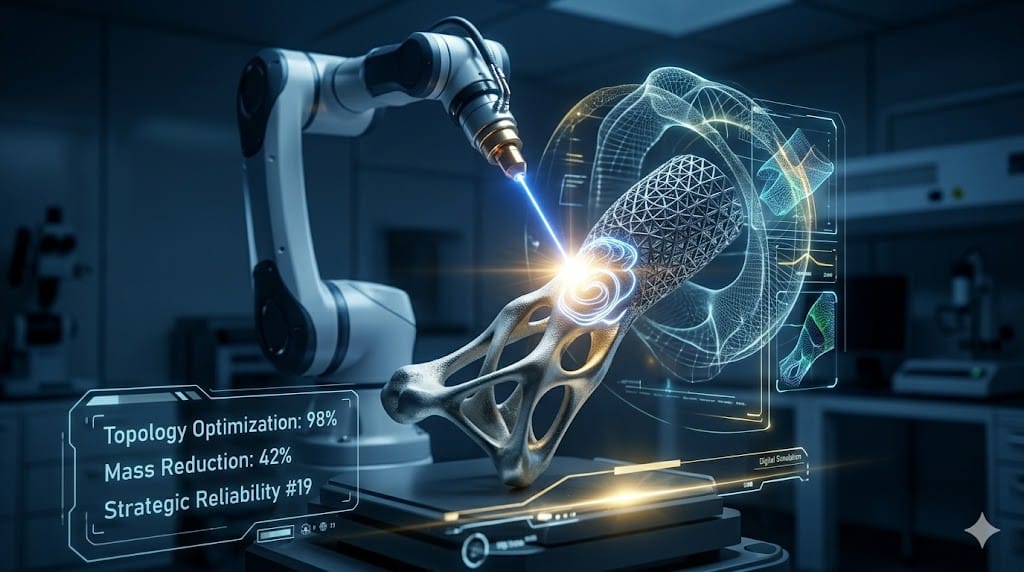
In traditional engineering, we design a part based on what a CNC mill or a casting mold can do. This often leads to “over-engineered” components—heavy, bulky parts that use more material than necessary.
At Intouchray (intouchray.com), our research into the future of EHLA (Article #33) is looking at a different path: Generative Design.
We are investigating a future where the software doesn’t just help us draw; it uses AI to “grow” the most efficient structure possible, specifically optimized for laser cladding.
This is the birth of the Self-Designing Part—the ultimate expression of Resource Efficiency (#19) and Noble Precision (#13).
- Beyond Human Geometry: Topology Optimization
Human designers tend to think in blocks, cylinders, and spheres. AI doesn’t. When we provide a “Generative Design” algorithm with the stress loads and attachment points of a component, it produces “Organic” or “Biomimetic” shapes that look more like bone or tree roots than traditional machinery.
Our research direction focuses on marrying these complex shapes with the high-speed deposition of the Intouchray beam. Because EHLA can deposit material exactly where the stress is highest, we can create components that are 40% lighter yet 20% stronger than their traditional counterparts. This is not just a design change; it is a Strategic Reliability upgrade.
- Material-as-a-Variable: The Digital Metallurgy Loop
The “Self-Designing” concept extends beyond the shape; it includes the Material Gradient (Article #64). In our visionary roadmap, the AI doesn’t just decide where the metal goes—it decides what the metal is at every microscopic point.
Dynamic Hardness: The AI might specify a ductile, vibration-absorbing core of stainless steel, seamlessly transitioning into a diamond-hard, wear-resistant surface of Tungsten Carbide exactly where the part experiences friction.
Thermal Management: For aerospace components, the design can “grow” internal cooling channels that are impossible to manufacture via any method other than integrated laser synthesis.
- From Algorithm to Atom: The Integrated Workflow
We are investigating a seamless “Digital-to-Physical” bridge. In this future workflow, there is no “Export to CAD” or manual setup.
The Objective: The technician defines the goal (e.g., “Repair this valve to survive 500 bar at 800°C”).
The Synthesis: The Intouchray AI generates the optimal repair geometry and material recipe.
The Execution: The data is pushed directly to the Swarm Intelligence (Article #72) robots, which begin the cladding process immediately.
- ROI: The Sovereign Asset
The “Self-Designing” approach transforms the economics of the industrial sector:
Zero Waste: We synthesize only the material required. No chips, no scrap, no excess.
Infinite Customization: Every repair is a “One-of-One” optimization. We don’t just return a part to “factory spec”; we evolve it to be better than it was when it was new.
Strategic Reliability: By eliminating the human error in geometric design, we ensure every cladded layer is mathematically perfect for its environment.
Conclusion: The Evolution of Making
Article #74 represents the “North Star” of our research. We are moving toward a future where the machine, the material, and the design are a single, unified intelligence. In Article #75, we look at the final piece of the autonomous puzzle: Self-Correction and the Zero-Defect Beam: When the Laser Learns from its Mistakes.
Image Attachment