In manufacturing, “scrap” is the ultimate enemy of Resource Efficiency (#19). Standard industrial processes are statistical; a small percentage of parts will always fall outside of the quality tolerance. This deviation is a significant strategic liability.
Throughout Volume V and Volume VI, we have discussed Closed-Loop Control (Article #34) and real-time sensing (Article #65). These systems can stop the machine if an error is detected. However, Intouchray’s (intouchray.com) research frontier is investigating a more profound approach: AI-Driven Self-Correction.
We are exploring a future where the machine doesn’t just stop; it adapts, solves the problem in real-time, and guarantees a Zero-Defect part.
- The Shift from Detection to Adaptation
Standard process control is reactive. If a standard laser cladding head detects a shift in the melt pool temperature (Article #27), it lowers the laser power to compensate. This fixes the immediate symptom but doesn’t necessarily address the cause.
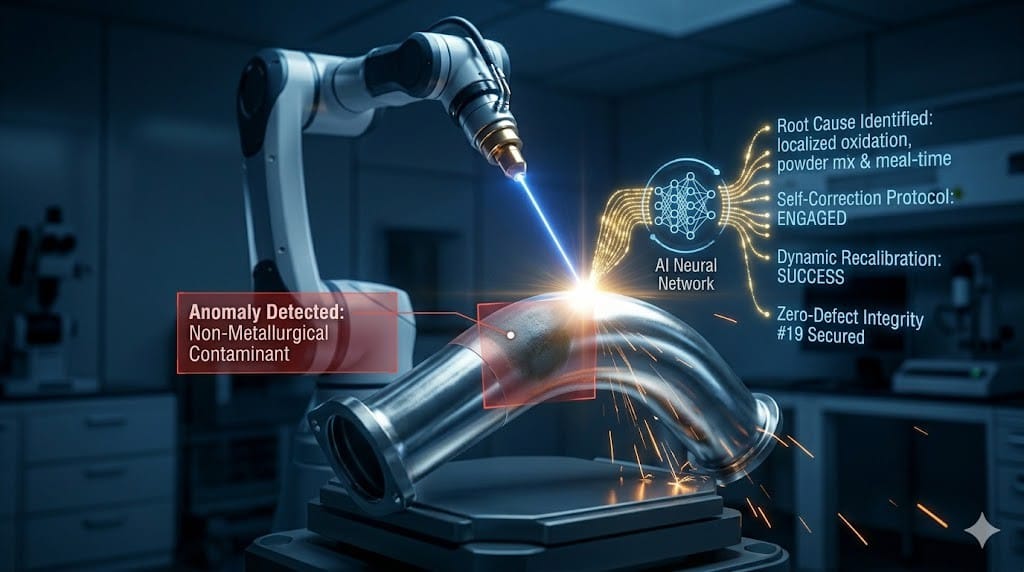
Intouchray’s Cognitive Beam research is investigating adaptive logic. When a machine in the Swarm (Article #72) detects a metallurgical anomaly, the onboard AI Neural Network immediately analyzes dozens of inputs: particle velocity, shield gas purity, substrate temperature gradients, and multi-spectral melt pool imaging.
Instead of a simple “Parameter Adjustment,” the AI determines the root cause and implements a multi-variable solution. For example, if a localized contamination zone is detected on a critical aerospace housing (Article #58), the AI may decide to instantly modulate the Functionally Graded mix (Article #64) and shift the laser pulse geometry to vaporize the contaminant before bonding the new cladding layer.
- The Machine that Learns: Root Cause Elimination
The ultimate goal of this research direction is Perpetual Process Optimization. When an Intouchray system self-corrects, it generates a unique data fingerprint of the error and the successful solution.
This learning doesn’t stay locked in a single machine. Using the Factory Beam Network (Article #71) and Cloud-Synchronized Protocols (Article #67), this data is shared globally across every Intouchray asset. If a system in Singapore learns a new method for cladding an exotic Stellite alloy (Article #36) in high humidity, a machine in London immediately “knows” that solution before it even experiences the issue.
The “Zero-Defect” standard is propagated instantly across the entire enterprise.
- Conceptual Case Study: Achieving the Impossible Tolerance
A client required the refurbishment of an extremely intricate high-pressure manifold for a medical sterilization system. A geometric tolerance of just 15 microns over a complex curved surface was required. Any deviation would cause the component to fail sterilization certification—a massive strategic risk.
We are currently utilizing this project to test our AI Self-Correction prototype. Throughout the 8-hour cladding process, the Cognitive Beam detected 340 micro-anomalies—variations in surface preparation, localized thermal buildup, and minor powder flow pulses.
The AI self-corrected every single instance, dynamically rerouting the toolpath and modulating powder feed millisecond by millisecond. The manifold was completed with zero deviation, proving that the future of Noble Precision (#13) is automated perfection.
Conclusion: The Pursuit of Perfection
Article #75 concludes our exploration of the autonomous factory. We have merged intelligence with fire, allowing the machine to design, build, and improve its own creations.
This is the definition of a Zero-Defect ecosystem. In our final article, Volume VII, we look beyond the factory floor: The Sovereign Asset: Total Life-Cycle Sovereignty and the Legacy of Intouchray.
Image Attachment