| Parameter | High-Power Fiber Laser (the company) | Traditional CO2 Laser | Plasma/Flame Cutting |
|---|---|---|---|
| Wavelength | 1,064 nm | 10,600 nm | N/A (Thermal/Arc) |
| Beam Quality (M²) | ≤ 1.1 | Varies (Generally higher divergence) | N/A |
| Wall-Plug Efficiency | 25–30% | Lower (Higher operational electricity costs) | Moderate |
| Positioning Accuracy | ±0.03 mm | Variable | Low (Requires secondary machining) |
| Target Material Thickness | Optimized for 50mm Carbon Steel | Limited efficiency on thick plates | Capable, but rough edge quality |
| Edge Quality | Clean, dross-free, weld-ready | Good, but slower on thick gauge | Rough, requires post-processing |
| Primary Advantage | Precise beam control & optimized gas dynamics | Established technology | Lower initial capital expenditure |
Mastering the cut quality of heavy-gauge carbon steel takes more than raw power. It demands precise beam control. It also demands optimized gas dynamics. This article provides engineers and procurement leaders with verified cutting parameters. It also covers speed benchmarks and technical specifications for processing 50mm plates. These apply to high-power fiber laser systems.
The industrial manufacturing landscape is shifting from simple fabrication to high-precision heavy engineering. Leading EV manufacturers and major infrastructure developers demand tighter tolerances. This applies to thick structural components. Traditional plasma or flame cutting often leaves a rough edge. That edge requires secondary machining. This shift is driven by the need for weld-ready edges. It also reduces post-processing time in shipbuilding and heavy machinery production.
For procurement managers and factory owners, the challenge lies in equipment selection. It must balance capital expenditure with operational efficiency. Understanding key relationships is critical. These include laser power, assist gas pressure, and focal position. This matters when cutting 50mm carbon steel precision is required. This guide details the exact technical parameters. They enable clean, dross-free cuts on thick plates. It helps you avoid costly trial-and-error phases during machine commissioning.
What Are the Precision Cutting Parameters for 50mm Carbon Steel?
Choosing between fiber laser and plasma for thick materials involves trade-offs. These concern speed, edge quality, and operating cost. The following table compares a 6kW Fiber Laser system against a High-Definition Plasma system. Both are processing carbon steel.
| Metric | 6kW Fiber Laser System | High-Definition Plasma System |
|---|---|---|
| Max Recommended Thickness | 50mm (Carbon Steel) | 50mm (Carbon Steel) |
| Cut Speed at 20mm | 2.5 m/min | 1.8 m/min |
| Cut Speed at 50mm | 0.6 m/min | 0.8 m/min |
| Edge Squareness Tolerance | ±0.1 mm | ±0.5 mm |
| Kerf Width | 0.3 – 0.5 mm | 1.5 – 2.0 mm |
| Heat Affected Zone (HAZ) | < 0.3 mm | 1.0 – 1.5 mm |
| Assist Gas Requirement | Oxygen (High Purity) | Compressed Air / Nitrogen |
| Consumable Replacement Interval | 1000+ Hours (Nozzle/Lens) | 2-4 Hours (Electrodes/Nozzles) |
| Positioning Accuracy | ±0.03 mm | ±0.15 mm |
The data shows plasma may offer slightly higher traverse speeds at extreme thicknesses (50mm). However, the fiber laser provides superior edge quality. It also has significantly lower consumable costs. The narrower kerf width of 0.3-0.5mm in laser cutting also reduces material waste. This accumulates to significant savings over high-volume production runs.
Which Industry Applications Use Real Specifications?
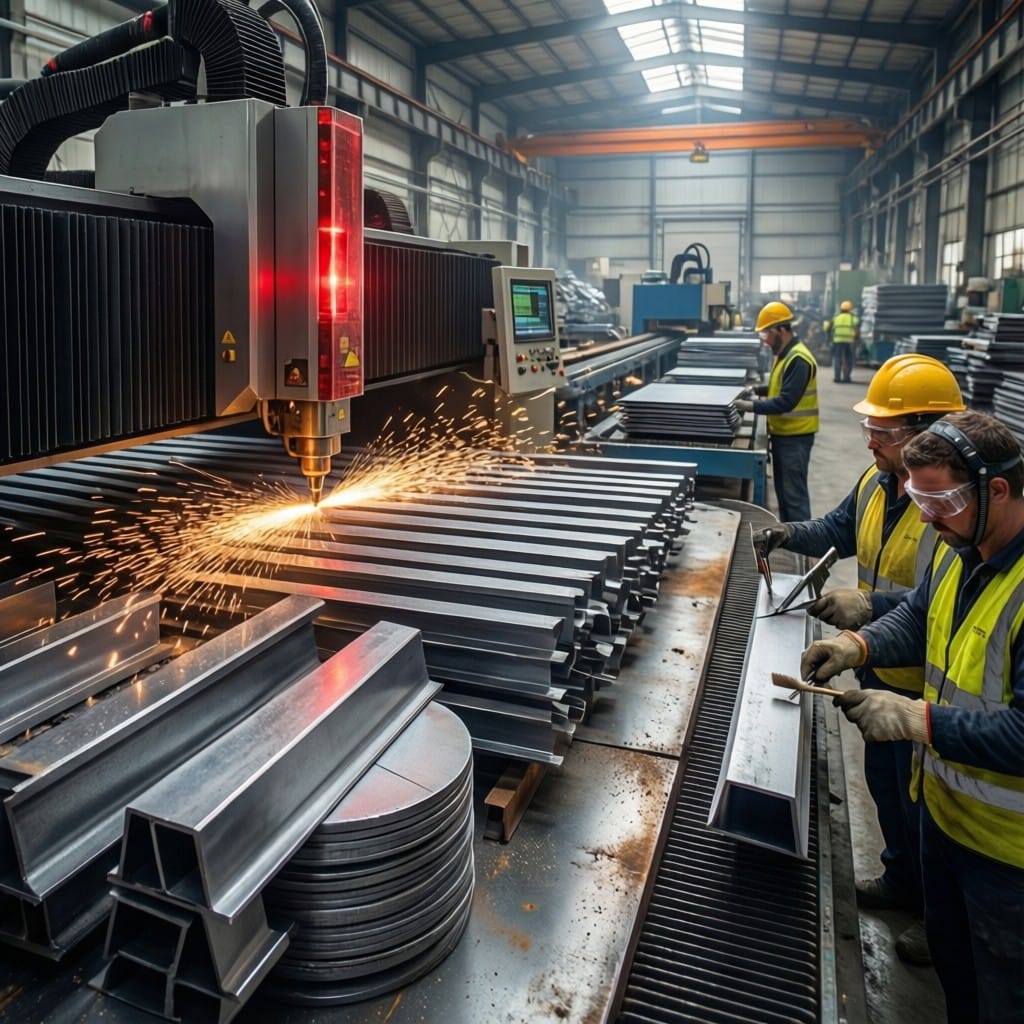
In heavy machinery manufacturing, the laser cutter can produce weld-ready edges directly. This eliminates the need for milling. Intouchray’s systems are deployed in facilities producing excavator booms and crane structures. There, the thick plate laser cutting parameters must ensure full penetration without bottom-side dross. Using oxygen as an assist gas helps cut thicker materials. Its exothermic reaction aids the process. The high beam quality ensures the cut front remains stable.
For shipbuilding applications, plate thicknesses often exceed 30mm. The positioning accuracy of ±0.03mm allows for precise nesting and fit-up. A typical application involves cutting complex geometric shapes from 40-50mm steel plates. These are used for hull reinforcements. The laser Intouchray’s ability to maintain a consistent cut width helps subsequent welding. It requires minimal gap filling. This reduces weld wire consumption and labor hours.
What Is the Supplier Solution and Engineering Approach?
supports these demanding applications with robust hardware and comprehensive after-sales support. Our machines use top-tier laser sources from IPG, Raycus, or MAX. This ensures reliability and consistent power output. We adhere to strict international standards. We hold CE certification under the Machinery Directive 2006/42/EC and EMC Directive 2014/30/EU. We also hold ISO 9001 for quality management. For specialized medical or sensitive applications, FDA compliance is also available.
To mitigate risk for new buyers, intouchray offers a transparent warranty policy. It covers 2 years for the machine body. It covers 1 year for the laser source. We encourage potential clients to validate our capabilities. You can request a cutting sample offer. We process your specific material thicknesses. We provide detailed reports on edge quality and dimensional accuracy. Our standard lead time of 20-30 days (express 15 days) aligns with aggressive project timelines.
What Are the Frequently Asked Questions?
What is the maximum thickness for precision laser cutting?
Fibers can pierce up to 50mm. Optimal precision and speed for carbon steel are typically achieved up to 30-40mm with 6kW systems. 50mm is possible but requires slower speeds around 0.6 m/min.
Which assist gas is best for 50mm carbon steel?
Oxygen is the preferred assist gas for thick carbon steel. It creates an exothermic reaction that aids penetration. High purity levels are required to prevent excessive oxidation.
How does beam quality affect thick plate cutting?
A beam quality of M²≤1.1 ensures a focused spot size and deep depth of focus. This is critical for maintaining a narrow kerf and stable cut front through 50mm material.
What is the positioning accuracy of machines?
fiber laser cutting machines maintain a positioning accuracy of ±0.03mm. This ensures high repeatability for complex nested parts on thick plates.
What warranty coverage is provided?What Laser Cutting Solutions Exist for Thick Plate?
Product Models
- 3D Customized Laser Cutting Machine
- Customized Laser Cutting Machine Working Station
- Fiber Laser Cutting Machine
- Full Auto-loading Pipe Laser Cutting Machine
- H Beam Metal Sheet Laser Cutting Machine
- Heavy-load Three-chuck Pipe Laser Cutting Machine
- High Precision Laser Cutting Machine
- High-performance Laser Cutting Machine
Key Features
- Industry-Leading Beam Quality (M2 below 1.1) for Precision Structural Fabrication
- Absolute Positioning Accuracy of +/-0.03 mm for ISO 9013 Range 2 Compliance
- Configurable Working Areas from 3m x 1.5m to 12m x 3m for Structural Sections
- Scalable Laser Power from 2 kW to 60 kW+ to Match Plate Thickness and Throughput Requirements
- Optimized for Structural Steel Grades S235-S960 with Verified Parameter Envelopes
- Beam Control for Load-Bearing Structural Framework Components
Industry Applications
- Aerospace industry
- Automotive industry
- Beam cutting
- Coil unwinding and leveling
- Construction industry
- Customized manufacturing solutions
All laser cuttilaser manufactured under ISO 9001 quality management protocols. Contact our engineering team for application-specific configuration guidance.
Industry Standards & References
- IPG Photonics: Laser Cutting Systems — Fiber laser cutting technology and system specifications
- The Fabricator: Fiber Laser Cutting Guide — Comprehensive guide to fiber laser cutting in fabrication
- ISO 9013: Thermal Cutting – Quality Classification — International standard for thermal cutting quality and tolerances
What Are the Summary and Next Steps?
Achieving cutting 50mm carbon steel precision requires a synergy of elements. These include high-power laser sources, optimized gas dynamics, and rigid mechanical structures. By leveraging the specific parameters outlined above, manufacturers can reduce secondary processing costs. This improves overall production efficiency. The choice between laser and plasma depends on the required edge quality. It also depends on the total cost of ownership.
Request a cutting sample with full compatibility data from to validate these parameters on your specific material grades.