Laser Cladding in the Mining Industry: Combating Severe Abrasion and Erosion
The mining industry operates in some of the world’s most hostile environments. Equipment—from massive excavation shovels and draglines to underground continuous miners and crushing machinery—is subjected to relentless degradation. The primary enemies are severe abrasion (the cutting and scratching by hard rock particles) and erosion (the wearing away by high-velocity particle streams, often in slurry).
Traditional wear solutions, such as sacrificial quenched-and-tempered (Q&T) steel plates or hardfacing via conventional welding (Article #01), provide limited protection. They are often thick, heavy, add significant mass, and require frequent replacement, leading to costly unscheduled downtime. High-power fiber laser cladding (Article #02, #08) offers a leapfrog alternative, applying thin, dense, metallurgically bonded (Article #11) wear-resistant coatings (Article #12, #13) that drastically extend component life and maximize extraction efficiency.
- The Mining Wear Challenge: Understanding the Enemy
Surface degradation in mining is rarely a single mechanism; it is usually a complex combination.
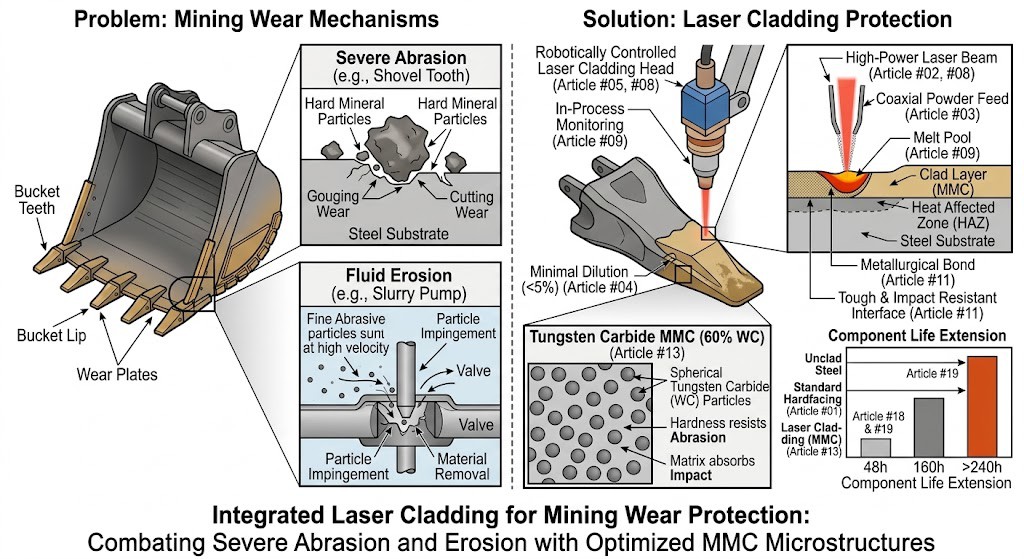
Abrasion: Hard mineral particles (like quartz or corundum) slide, gouge, or cut into the surface of ground-engaging tools (GETs). This microscopic “plowing” action rapidly removes material, dulling cutting edges and reducing efficiency. Shovel teeth, bucket liners, and conveyor components are primary targets.
Erosion: Fine abrasive particles, often suspended in water (slurry), strike surfaces at high velocity. This “sandblasting” effect erodes material, particularly in pumps, pipes, cyclones, and valve components.
Corrosion: Mining environments are frequently wet and chemically aggressive (e.g., acid mine drainage), accelerating material loss through electrochemical attack, which synergistically worsens wear rates.
- Laser Cladding: The Advanced Defense Strategy
Laser cladding combats these severe wear mechanisms by depositing specialized materials (Article #03, #12, #13) precisely where needed. This advanced strategy delivers several critical advantages tailored to mining applications.
Noble Metallurgical Bond (Article #11)
Unlike mechanical bonds (e.g., thermal spray), laser cladding creates a full metallurgical bond with the substrate. As detailed in Article #11, precise heat control (often with adaptive feedback, Article #09) ensures minimal dilution (<5%, Article #04) and a refined bond interface. This prevents delamination even under the massive impact and shear loads common in excavation and crushing.
Application-Specific Wear Materials (Article #13)
The flexibility of the laser process (Article #08) allows for the application of materials engineered specifically for severe mining wear:
Tungsten Carbide MMCs (Article #13): The ultimate defense against abrasion. As detailed in Article #13, MMCs (Metal Matrix Composites) blend extremely hard, spherical tungsten carbide (WC) particles within a tough, impact-resistant nickel or cobalt matrix. The carbide provides the hardness to resist cutting, while the matrix absorbs energy, preventing fracture.
Nickel-Based Superalloys (Article #12): Used where erosion and corrosion (Article #12) are the primary threats. These alloys maintain their strength and stability in wet, aggressive chemical environments, outperforming standard steel hardfacing.
- Case Study: Extending Shovel Tooth Life
Shovel teeth and adapters are some of the highest-volume consumables in mining. A large copper mine was changing sacrificial teeth every 48 hours due to extreme abrasion, resulting in significant maintenance downtime and lost production. Traditional hardfacing extended this to 72 hours, still requiring frequent replacement.
The Solution: The shovel teeth were laser cladded with a specialized Tungsten Carbide MMC (60% WC by weight) using an Intouchray automated cladding cell (Article #08).
The Result: The laser-cladded teeth operated for over 240 hours before replacement—more than a 3x life extension compared to hardfacing and 5x compared to bare Q&T steel. This single optimization drastically reduced unscheduled downtime, increased shovel utilization, and maximized total tons of ore moved per shift, delivering a profound ROI (Article #18).
Conclusion: Driving Extraction Efficiency and ROI
In the competitive mining landscape, equipment uptime is paramount. High-power fiber laser cladding (intouchray.com) transforms surface engineering from reactive hardfacing into a proactive strategy for strategic reliability. By applying metallurgically bonded (Article #11), application-specific Tungsten Carbide MMCs (Article #13), manufacturers and operators can drastically extend the life of ground-engaging tools and process equipment. This technology doesn’t just reduce wear; it maximizes total cost of ownership by transforming component reliability into a measurable core asset, ensuring that the world’s largest industrial operations achieve peak extraction efficiency and noble ROI in the face of nature’s relentless erosion.
Image Attachment