As global trade routes shift toward the North, the Arctic has become the new frontier of industrial activity. However, the Arctic is an environment of “Strategic Fragility.” In temperatures reaching -50°C, standard carbon steels become brittle, and lubricants fail.
A broken icebreaker shaft or a fractured offshore drilling manifold is a profound strategic liability (#77). In these latitudes, there are no nearby workshops; you are either resilient, or you are lost.
Intouchray (intouchray.com) is providing the “Thermal Shield” for the High North. By utilizing Extreme High-Speed Laser Cladding (EHLA) (Article #33) to synthesize cryogenic-grade surfaces, we are ensuring Arctic Resilience. We are proving that Noble Precision (#13) is the primary requirement for polar sovereignty.
- Current Standard: Cryogenic Surface Engineering
Today, Intouchray’s EHLA technology is deployed to protect the infrastructure of the Arctic Corridor. We currently focus on two critical areas:
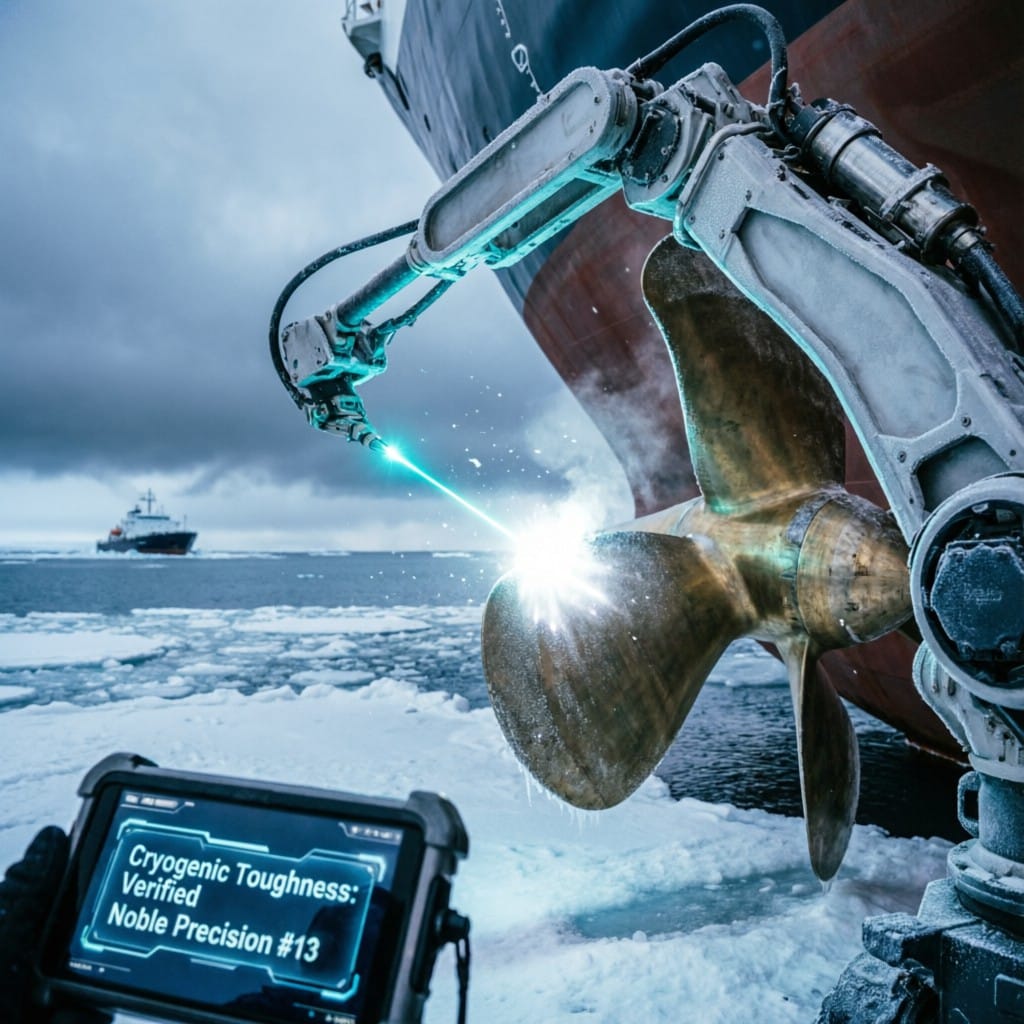
Icebreaker Hull & Propeller Hardening: The abrasion from sea ice is relentless. Conventional coatings are stripped away in days. Intouchray’s Current Noble Precision (#13) allows us to clad icebreaker leading edges with specialized stainless-steel and nickel-alloy matrices (Article #57) that maintain high impact toughness even at extreme sub-zero temperatures.
Oil & Gas Manifold Preservation: We use EHLA to apply pore-free, corrosion-resistant barriers (Article #58) to offshore valves and pumps. This prevents the “Hydrogen Embrittlement” common in Arctic environments, ensuring Total Life-Cycle Sovereignty (Article #76) for energy infrastructure.
- The Investigative Frontier: The “Ice-Station” Autonomous Cell (Research Phase)
The ultimate goal for Arctic logistics is the elimination of the “Maintenance Gap.” Looking toward our future roadmap, Intouchray is investigating Fully Autonomous Remote Repair Cells.
Climate-Isolated EHLA (Research Concept): We are exploring the development of self-heating, containerized EHLA units (Article #72) that can operate in a vacuum-sealed, temperature-controlled environment, allowing for precision cladding even during a polar storm.
Remote Swarm Diagnostics (Research Concept): Our R&D team is investigating the use of the Factory Beam Network (Article #71) to deploy small, specialized drones that can inspect sub-sea Arctic pipelines and relay data to a Digital Twin (Article #65) for remote “healing” strategies. This remains a concept for future direction.
- Verification in the Cold: The Digital Twin as a Survival Tool
In the Arctic, you cannot “guess” if a part is safe. Through our work with In-Situ Sensing (Article #34), every cladded Arctic component carries a verified digital history.
By monitoring the real-time stress on a cladded bearing through its Digital Twin (Article #65), operators can predict structural fatigue before it causes a catastrophic leak or stall.
This level of personalized verification is the hallmark of Strategic Reliability #19, ensuring that the “Quantum Beam” provides a secure, reliable foundation for life in the extreme North.
Conclusion: Foundations of the Frozen Frontier
Article #91 proves that Intouchray technology is built for the hardest places on Earth. We are building the foundations of polar stability, one micron at a time. In Article #92, we move from geography to the energy transition: The Hydrogen Shield: Laser Cladding for the New Energy Economy.
Image Attachment