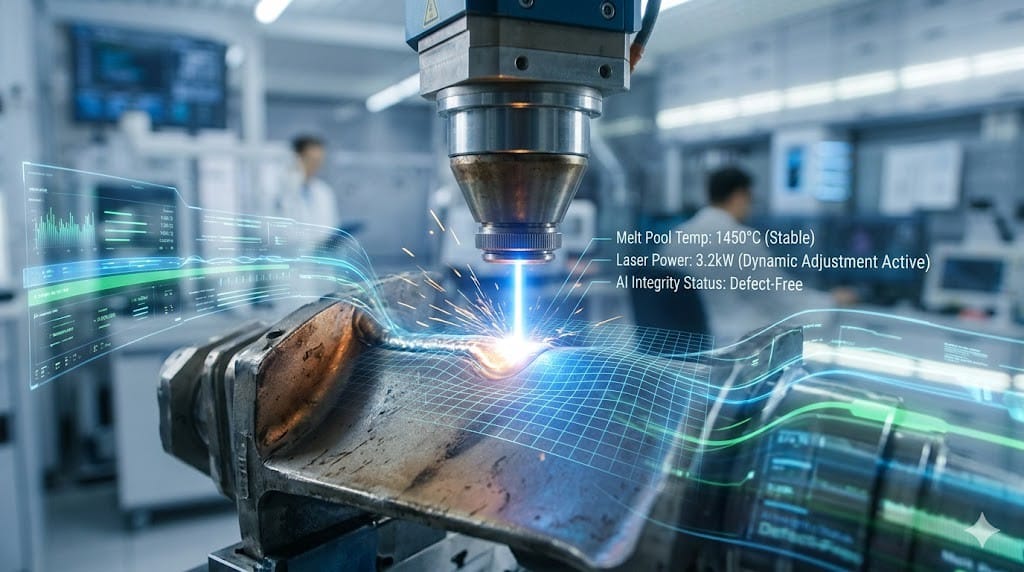
As laser cladding moves into critical sectors like aerospace engine repair (Article #51) and nuclear valve maintenance (Article #53), the demand for zero-defect manufacturing has become absolute.
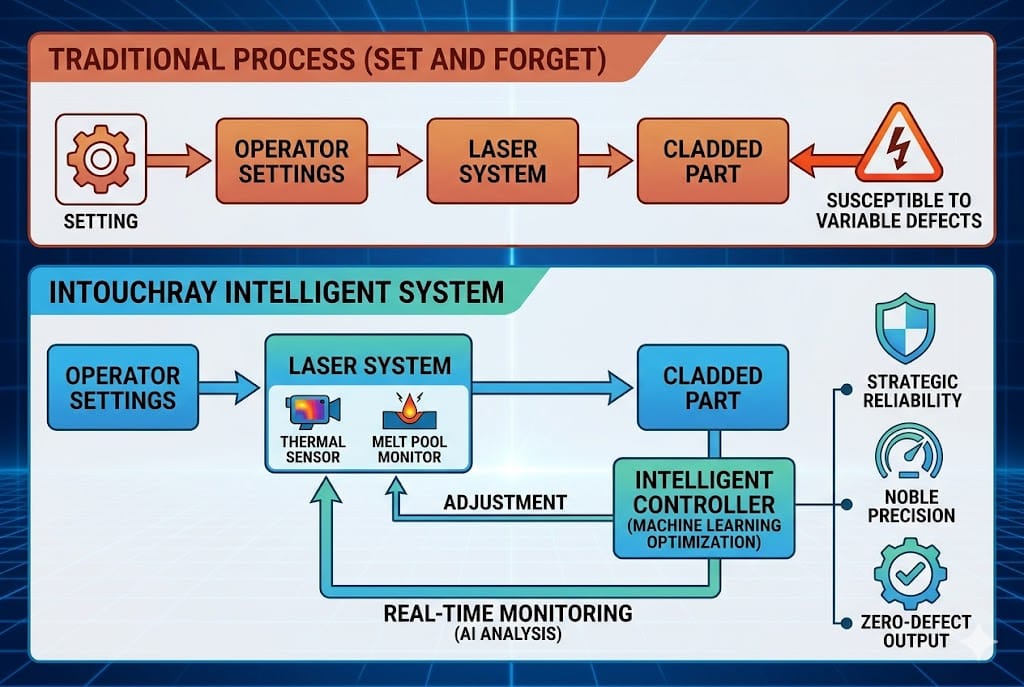
Traditional “Open-Loop” cladding—where parameters are set once and the machine runs passively—is no longer sufficient. Environmental variables, such as substrate temperature changes or fluctuating powder flow, can introduce microscopic defects that compromise strategic reliability.
Intouchray Intelligent Systems are bridging this gap by integrating advanced sensing, Machine Learning (AI), and real-time Closed-Loop Control (Article #34), transforming the laser from a dumb heating element into a responsive, decision-making instrument of noble precision.
- The Sensors: The Eyes and Ears of the Process
To control the process, the system must first perceive it. Intouchray utilizes a multi-sensor suite to monitor the complex physics occurring at the localized melt pool (Article #45).
Pyrometry and Thermal Imaging: High-speed, high-resolution infrared cameras and dual-wavelength pyrometers monitor the temperature of the melt pool and the surrounding Heat-Affected Zone (HAZ). They can detect deviations as small as 10°C at microsecond speeds.
Optical Melt Pool Monitoring: Coaxial cameras (looking directly down the laser beam path) analyze the geometry, stability, and brightness of the melt pool. This allows the system to differentiate between a healthy, fluid pool and one about to cause spattering or lack of fusion.
Powder Flow Sensing: Optical sensors monitor the consistency of the metallic powder stream, ensuring the precise “metallurgical recipe” is maintained.
- Closed-Loop Control: Real-Time Stabilization
The core of an intelligent Intouchray system is the Closed-Loop Feedback Controller. This system compares the real-time sensor data against the idealized master parameters. If a deviation is detected (e.g., the substrate is overheating), the system reacts in milliseconds, not by stopping, but by dynamically adjusting the process on the fly.
Dynamic Power Adjustment: If the thermal camera detects excessive heat build-up, the controller instantly reduces the fiber laser power density (Article #33) to maintain optimal melt pool temperature, preventing grain growth and dilution issues.
Variable Speed Control: If the melt pool geometry fluctuates, the robotic cladding speed or rotary table RPM can be adjusted dynamically to maintain uniform cladding thickness and noble precision edge retention.
This stability is essential for maintaining certification in high-value asset re-manufacturing.
- Artificial Intelligence and Machine Learning (ML)
While closed-loop control stabilizes the process, AI and ML provide the optimization.
Parameter Prediction: ML algorithms analyze historical cladding data from thousands of successful depositions. Given a specific repair geometry and material (e.g., Inconel 718 on Ti-6Al-4V), the AI predicts the optimal starting parameters, reducing costly “test clads.”
In-Situ Defect Detection: The most revolutionary application of AI is “In-Situ Monitoring.” By analyzing acoustic and thermal signatures, the AI can detect the onset of microscopic cracking or porosity as it happens. The system can automatically flag the defect, attempt an automated repair sequence (re-melting the area), or halt the process before a critical part is ruined, maximizing resource efficiency (#19).
- Optimized Quality and Strategic Reliability
The integration of AI and closed-loop control transitions laser cladding from a skilled trade into a data-driven science.
Zero-Defect Manufacturing: Reactive control eliminates stochastic defects caused by process variables, guaranteeing that every cladded layer meets flight-critical or pressure-critical standards.
Extended Tool Life: Machine Learning algorithms constantly optimize the process to use the minimum heat and powder required, reducing residual stress and extending the life of both the machine and the cladded component.
Conclusion: The Autonomous Future
Article #56 has shown that intelligence is the necessary evolution of laser technology. By giving the beam the ability to see, feel, and think, Intouchray ensures that noble precision is not just an aspiration, but a predictable, repeatable result. We have optimized geometry and metallurgy; we are now optimizing information. In Article #60, we wrap up Volume IV with a look at Laser Cladding for the Steel Industry: Toughening the Rolls.
Image Attachment